
Quick answer: Epoxy coatings are refinishing products applied over a prepared existing surface, while factory finishes may be fired porcelain enamel, molded gel coat, or the finished surface of an acrylic fixture. A professionally applied coating can last for years with proper care and generally costs less than replacement, but it does not reproduce the original factory manufacturing process.
Key takeaways
- A factory finish is the fixture’s original fired, molded, or finished surface; refinishing can restore its appearance but cannot duplicate the factory process on-site.
- Epoxy coatings are applied over a prepared existing surface, and their service life depends on the coating system, surface preparation, use, and care.
- Angi reports professional reglazing averages around $480, compared to roughly $5,520 for a full tub replacement with installation.
- Fiberglass, porcelain, cast iron, and enamel tubs can all generally be epoxy-coated, but each material affects cost and prep work differently.
- New Jersey regulates the VOC content of architectural coatings, so ask any contractor whether their epoxy products meet current state limits.
What Is a Factory Finish, and Why Does It Wear Out?
A factory finish is the original surface applied to a bathtub, sink, or tile when it was manufactured. On cast iron and steel tubs, this is usually a baked-on porcelain enamel fused to the metal at extremely high temperatures. On fiberglass tubs, the factory finish is a gel coat sprayed into the mold before the fiberglass shell cures. Acrylic tubs are colored all the way through, so their “finish” is really the top layer of the same material.
These factory processes create a strong initial bond, but they are not permanent. Hard water, humidity, and years of cleaning with abrasive products wear down the glossy top layer over time. Wear can be especially noticeable in older properties and humid bathrooms, including homes in Toms River, Brick, and Point Pleasant. Once the factory finish is compromised, exposed metal may rust, while fiberglass fixtures may require separate evaluation for delamination and peeling.
What Is Epoxy Coating, and How Is It Different?
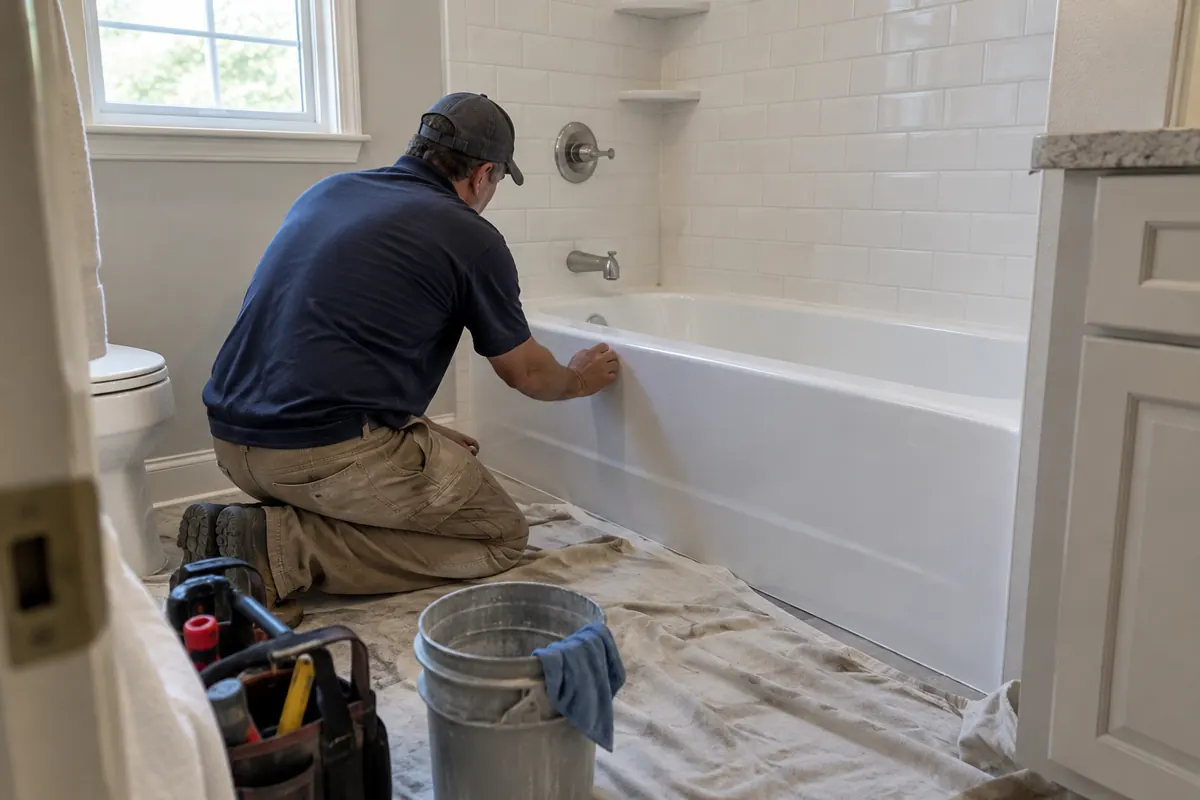
Epoxy coating is a refinishing product applied over an existing surface rather than built into the material during manufacturing. The process generally involves cleaning and abrading or chemically preparing the old surface, repairing minor defects, applying the specified primer, and then applying the coating system according to the manufacturer’s instructions. According to Angi, professional reglazing typically takes a few hours of labor, which lines up with what we see on most residential jobs.
Unlike a factory finish, epoxy does not become part of the base material. It forms a hard, glossy layer on top of it. That difference matters for durability and repair: epoxy can be reapplied or touched up later, while a damaged factory finish on an old tub usually cannot be restored without a full refinishing or replacement.
Epoxy vs Factory Finish: Side-by-Side Comparison
The table below summarizes the practical differences homeowners care about most: lifespan, cost, and how each option holds up over time.
| Factor | Factory Finish (Original) | Epoxy Coating (Refinished) |
|---|---|---|
| How it’s applied | Baked or molded in at the factory before installation | Applied on-site over an existing surface by a technician |
| Care requirements | Use nonabrasive cleaners and repair chips promptly to protect the original surface | Use nonabrasive cleaners and avoid harsh chemicals that can damage the recoated surface |
| Typical cost | Included with a new fixture; Angi reports about $5,520 on average for full tub replacement with installation and plumbing | About $300 to $900 for professional refinishing, according to Angi; material and condition can change the price |
| Repairability | The factory process cannot be recreated on-site, but a worn surface may be repaired or refinished | Minor damage may be repairable; extensive failure can require stripping and recoating |
| Color and finish options | Limited to what was manufactured | Wide range, including custom colors and sheens |
| Best suited for | New construction or full remodels | Older tubs, sinks, and tile in otherwise sound condition |
Cost figures are national estimates from Angi; local quotes differ.
For a closer look at how reglazing stacks up financially against buying new, see our breakdown on why resurfacing beats replacing a porcelain tub.
Which Tub Materials Work Best With Epoxy Coating?
Most common bathtub materials can accept an epoxy coating, though prep work and expected results vary.
- Porcelain and enamel over cast iron or steel: These can be refinished when the surface is sound and prepared with methods and primers compatible with the selected coating system. HomeAdvisor reports porcelain refinishing averages around $475.
- Cast iron: A dense, stable base that holds epoxy well, though rust along chips needs to be treated first (see our guide on removing rust stains from tubs).
- Fiberglass and acrylic: These can be coated too, but if the gel coat has already separated from the shell, epoxy alone will not fix the underlying problem. That calls for delamination repair first.
- Antique porcelain tubs: Tubs over 100 years old often need extra surface preparation, and HomeAdvisor notes these jobs can run $500 to $1,200 due to the added labor.
If you are unsure what your tub is made of, our bathtub resurfacing in New Jersey page outlines how we evaluate material and condition before quoting a job.
How Long Does Each Option Actually Last?
A well-maintained factory finish on a quality cast iron or steel tub can last decades before it starts to dull, stain, or chip. Fiberglass gel coats can dull, crack, or wear with age and use, and any underlying flexing or delamination should be repaired before recoating.
The service life of an epoxy coating varies with surface preparation, product selection, application, use, and cleaning practices. Lifespan depends heavily on application quality, product choice, and daily use. Angi lists DIY kits at about $30 to $150, but results depend on following the product’s preparation, ventilation, application, and curing instructions. Jemco Reglazers has more than 15 years of hands-on experience and serves areas including Ocean, Hudson, Essex, Mercer, and Somerset counties. Careful surface preparation is important to coating adhesion and durability.
New Jersey regulates the VOC content of covered architectural coatings under N.J.A.C. 7:27-23. The New Jersey Department of Environmental Protection says amendments became effective on August 18, 2025, with new VOC limits becoming operative on August 18, 2026. Ask the refinisher which products will be used, whether they comply with applicable New Jersey VOC limits, and what ventilation and re-entry precautions the product labels and safety data sheets require.
Epoxy Coating: Pros and Cons
Epoxy refinishing is a popular choice for a reason, but it is not the right fit for every situation.
Pros
- Costs a fraction of full replacement; Angi estimates average reglazing around $480 versus about $5,520 installed for a new tub.
- Most projects are completed in just a few hours of on-site work.
- Allows custom colors and finishes not available from the original manufacturer.
- Can restore tubs, sinks, tile, and countertops that are structurally sound but cosmetically worn.
Cons
- Will not fix structural problems such as leaks, severe cracks, or delaminated fiberglass.
- Requires a curing period, generally in the 24 to 48 hour range cited by HomeAdvisor, before the surface can be used again.
- Needs gentle cleaning products afterward; abrasive cleaners shorten the coating’s lifespan.
- Quality depends heavily on surface prep and applicator skill, which varies widely between DIY kits and professional service.
Factory Finish: Pros and Cons
Sticking with an original factory finish, or opting for full replacement when a tub is beyond repair, also has real tradeoffs.
Pros
- Factory application occurs in a controlled manufacturing environment, although fixture quality and installation still vary.
- Long baseline lifespan when the fixture is well made and properly maintained.
- A newly installed fixture can be used after the plumbing, sealants, and other installation materials are ready under their manufacturers’ instructions.
Cons
- Full replacement costs significantly more; HomeAdvisor and Angi both put installed tub replacement in the thousands of dollars.
- Demolition, plumbing, finish work, and installation can make replacement more disruptive than recoating an intact tub.
- Limited to the colors and finishes the manufacturer originally offered.
- Once a factory finish fails on an older tub, repair options are limited compared to a fresh epoxy coat.
When to Choose Epoxy, and When to Call a Professional
Epoxy coating makes sense when the underlying tub, sink, or tile is structurally sound but cosmetically tired, stained, or outdated. This covers a large share of the older housing stock across Toms River, Freehold, Howell, Jackson, Lakewood, Manchester Township, and the broader Ocean County and Essex County areas.
Full replacement, rather than coating, is the better call when there is an active leak, a crack that goes through the shell, significant rust-through on a cast iron tub, or fiberglass that has separated from its backing. A licensed plumber should also be consulted any time a coating or repair project might affect drain lines, overflow assemblies, or water supply connections.
For most intact tubs, sinks, and tile, professional epoxy refinishing offers a practical middle ground between living with a worn surface and paying for a full remodel. Jemco Reglazers is a family-owned business based in Toms River with more than 15 years of hands-on experience in bathtub, tile, sink, and countertop refinishing, serving listed areas across New Jersey with honest, no-pressure service.
Browse our gallery of completed reglazing work or see our full list of bathroom refinishing services to compare options for your specific fixture.
Frequently Asked Questions
Can you epoxy coat over a factory finish?
A compatible epoxy coating may be applied over a sound factory finish after the surface is cleaned, repaired, and prepared as the coating manufacturer specifies. Reglazing systems and preparation methods vary by substrate, and active leaks or structural damage should be addressed first.
Does epoxy coating look as good as a factory finish?
A professionally applied epoxy coating can achieve a comparable gloss and smoothness to a factory finish, and it offers more color choices. The main visual difference shows up over time, since epoxy may require recoating sooner than a high-quality original finish on certain materials like cast iron.
How do I know if my tub needs epoxy coating or full replacement?
If the tub is intact with no leaks, major cracks, or rust-through, epoxy coating is usually the more cost-effective option. If there is structural damage, delamination, or persistent leaking, replacement or professional repair before coating is the safer route.
Is epoxy coating safe to apply in an occupied home?
Epoxy products contain volatile organic compounds, so proper ventilation during application is important, and New Jersey regulates VOC limits for architectural coatings under state law. Application should follow the product label and safety data sheet for ventilation, protective equipment, curing, and re-entry requirements.
Will epoxy coating fix stains that a factory finish won’t?
Refinishing can cover residual discoloration after the surface has been properly cleaned and prepared, but active rust must be removed or treated and its cause addressed before coating. For stubborn rust specifically, pretreatment is usually needed before coating for the best long-term result.
Sources
- What Is Bathtub Reglazing? | Angi
- How Much Does It Cost to Refinish a Bathtub? | HomeAdvisor
- N.J. Admin. Code § 7:27-23.3 – Standards | Cornell Legal Information Institute
- Revisions to N.J.A.C. 7:27-23 and 24 Architectural Coatings and Consumer Products | NJ DEP
Written by the team at Jemco Reglazers, a family-owned New Jersey bathtub and tile reglazing company with over 15 years of hands-on experience restoring bathroom surfaces.