
Quick answer: Bathroom countertop refinishing restores worn laminate, cultured marble, or solid-surface vanity tops by repairing chips and recoating the surface, instead of tearing out and replacing the whole counter. Angi reports that countertop resurfacing can run $100 to $1,200 nationally, while full bathroom countertop replacement can run $400 to $4,300, so refinishing may cost less when the existing top is a suitable candidate.
Key takeaways
- Countertop refinishing repairs the existing vanity top surface instead of tearing it out, which generally costs less and takes far less time than full replacement.
- Angi data puts national countertop resurfacing costs at roughly $100 to $1,200, while full bathroom countertop replacement runs $400 to $4,300; costs vary with size, material, and sink configuration.
- Laminate, cultured marble, and solid-surface vanity tops can all be refinished, but severely delaminated laminate or cracked-through solid surface may need replacement instead.
- Humidity, standing water, and mineral buildup can contribute to vanity-top wear, while a properly refinished surface can be easier to keep clean.
- Most countertop refinishing projects are completed in a matter of hours, with the surface ready for normal use within about a day under good drying conditions.
What Is Bathroom Countertop Refinishing?
Bathroom countertop refinishing means repairing the existing vanity top and applying a new coating or finish over it, rather than removing and replacing the whole countertop. It works on cultured marble, laminate, and many solid-surface vanity tops that are structurally sound but worn, stained, chipped, or simply outdated in color.
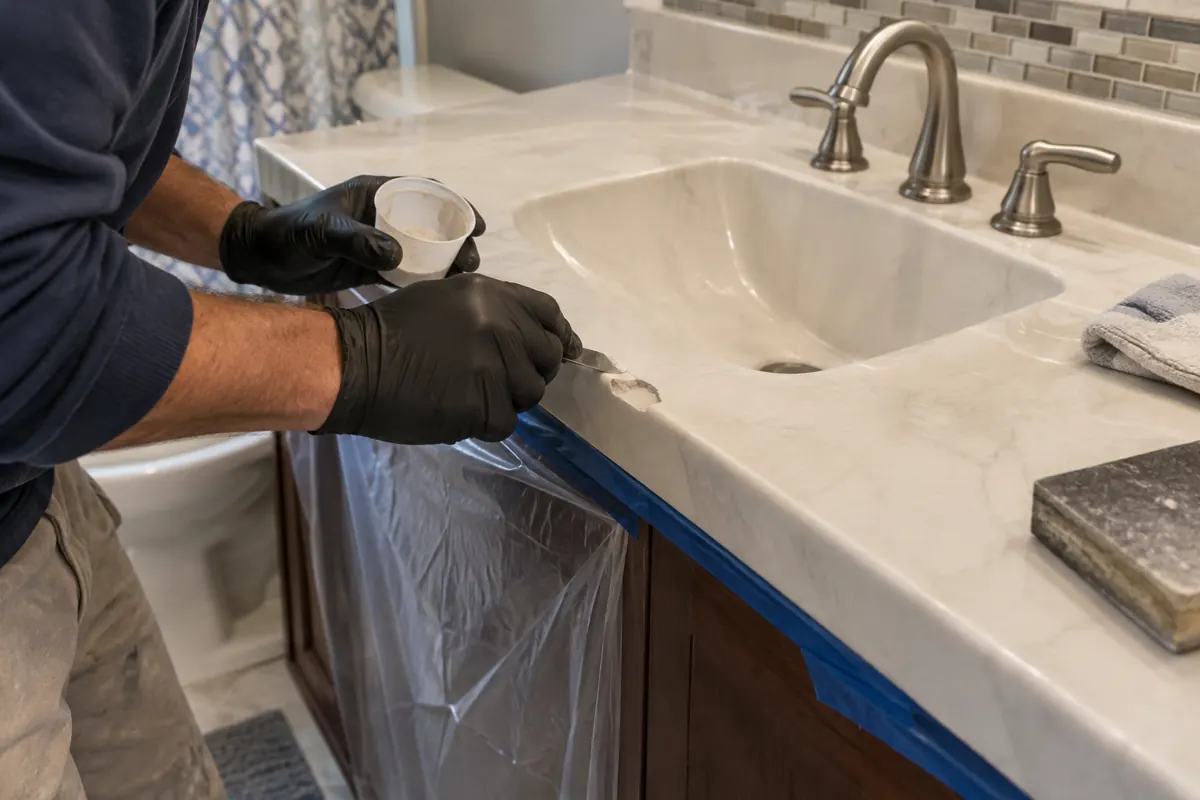
The process typically starts with cleaning and repairing any chips, cracks, or cigarette burns in the surface. Technicians then sand or prep the countertop so a bonding primer and topcoat will adhere properly, and finish with a durable coating in the color and sheen the homeowner wants. The sink basin, if it is integrated into the countertop (as with cultured marble vanity tops), is typically refinished along with the top as one continuous surface.
This is different from replacing a countertop, which involves removing the old top, disconnecting plumbing, and installing a new slab or laminate surface. Refinishing works with what is already there, which is why it tends to be faster and less disruptive.
Laminate Countertop Resurfacing: What to Know
Laminate vanity tops remain common in many New Jersey homes, and some are still structurally sound even when the surface looks dated or worn. Laminate can peel or bubble at the edges over time, especially in humid bathrooms or near the sink where water sits repeatedly.
Resurfacing laminate involves repairing any lifted edges or delamination, filling chips, and applying a bonded coating over the existing laminate surface. This works well when the laminate itself is still firmly attached to the substrate. If the laminate has separated extensively from the particleboard underneath, that is a sign of delamination damage that coating alone will not fix permanently, and the vanity top may need more invasive repair or replacement.
A good contractor will tell you honestly which situation you are in before starting work. Refinishing over badly delaminated laminate is a short-term fix that usually fails faster than expected, so it is worth asking directly whether your countertop is a good refinishing candidate.
Solid Surface and Cultured Marble Vanity Top Repair
Cultured marble and solid-surface vanity tops are found in many NJ bathrooms, including older homes and rental properties. These materials can develop hairline cracks, dullness, yellowing, or hard-water etching over the years, especially where mineral-heavy well water or municipal hard water is common.
Depending on the material and damage, repair may include filling chips or cracks, polishing suitable solid-surface material, or refinishing the vanity top with a compatible coating. Because the sink bowl is molded into the countertop on most cultured marble vanities, refinishing treats the counter and sink as one piece, which keeps the finish consistent and avoids visible seams.
This is a different scope of work than kitchen sink reglazing, which focuses on stainless or porcelain kitchen basins rather than integrated bathroom vanity tops.
Refinish vs. Replace: How to Decide
Not every countertop is a good refinishing candidate, and an honest contractor should tell you that upfront rather than coat a counter that is better off replaced. Here is a general checklist for deciding which route makes sense.
- Good refinishing candidates: surface stains, dullness, minor chips, small cracks, dated color, light hard-water etching, and laminate with intact edges.
- Better candidates for replacement: extensive delamination, large structural cracks through the material, water-damaged substrate underneath laminate, or a countertop that needs a different size, layout, or sink cutout.
- Budget consideration: resurfacing can save a substantial amount compared to full replacement, since Jemco Reglazers notes that resurfacing work in general can save up to 70% compared to full replacement.
- Timeline consideration: replacement often involves ordering materials, scheduling installers, and plumbing disconnection and reconnection, while refinishing can avoid many of those steps.
If you are weighing this decision for a full bathroom, it is also worth reading about why resurfacing beats replacing a porcelain tub, since the cost-and-timeline logic is similar for vanity tops.
How Much Does Bathroom Countertop Refinishing Cost?
Costs vary by material, damage severity, and countertop size, so any number should be treated as a general estimate rather than a quote. According to Angi, professional countertop repair nationally costs between $100 and $1,200, with resurfacing specifically running roughly $100 to $1,200 and refinishing around $200 to $600 depending on scope. HomeAdvisor reports an average repair/refinish cost of about $378, with a typical range of $214 to $548, noting that minor crack repairs and epoxy coating sit on the lower end while more extensive tile-counter grout work sits higher.
For comparison, Angi estimates full bathroom countertop replacement runs $400 to $4,300 nationally, averaging around $2,300, once you factor in material costs, removal and disposal, and plumbing adjustments that can add $350 to $1,800 on their own. The table below summarizes the general cost picture.
| Project Type | Typical Cost Range (national estimates) | What Drives the Cost |
|---|---|---|
| Minor chip or crack repair | $150–$1,000 | Number and size of chips, material type, accessibility |
| Countertop resurfacing/refinishing | $100–$1,200 | Surface area, material (laminate vs. solid surface), coating type |
| Full countertop replacement | $400–$4,300 | Material choice, slab size, sink reconnection, removal and disposal |
These figures come from Angi and HomeAdvisor’s published national data, not from Jemco Reglazers pricing. For an exact number on your specific vanity top, request a local estimate. For a broader look at factors that move reglazing costs across different surfaces, see this breakdown of a common reglazing pricing mistake to avoid.
What the Refinishing Process Looks Like
- Inspection and prep: the technician checks for delamination, structural cracks, or water damage that would rule out refinishing.
- Repair: chips, cracks, and chipped edges are filled and smoothed.
- Surface prep: the countertop is cleaned, sanded, and masked off to protect cabinets, walls, and fixtures.
- Primer and bonding coat: a bonding agent is applied so the new finish adheres properly to laminate, cultured marble, or solid surface.
- Topcoat application: the final color and finish (gloss, satin, or matte depending on preference) is sprayed or rolled on.
- Cure time: the surface needs time to harden before normal use resumes.
Jemco Reglazers, a family-owned business based in Toms River with 15-plus years of hands-on experience, notes that most resurfacing projects are completed in just a few hours, with the finished surface ready to use within 24 hours. That timeline makes countertop refinishing a practical option for a single bathroom that cannot be out of service for days.
Caring for a Refinished Vanity Top
A newly refinished countertop needs gentle care to last. Avoid setting hot curling irons or flat irons directly on the surface, since sustained heat can damage most coatings. Stick to non-abrasive cleaners and soft cloths rather than scouring pads or harsh chemical cleaners, which can dull the finish over time.
Where mineral spotting occurs, wiping the counter dry after use helps limit buildup that can dull or mark a fresh finish. If you are unsure which products are safe, it is worth asking your contractor directly rather than guessing, since the wrong cleaner can shorten the life of an otherwise solid refinishing job.
For bathrooms where tile surrounds the vanity, pairing countertop refinishing with tile reglazing in NJ creates a more consistent, updated look throughout the space.
When Countertop Refinishing Fits Into a Bigger Bathroom Update
Vanity top refinishing rarely happens in isolation. Many homeowners pair it with tub resurfacing, tile color updates, or grout repair to refresh an entire bathroom without a gut renovation. Jemco Reglazers offers full bathroom surface restoration services across Toms River, Brick, Manchester Township, Lakewood, Jackson, and surrounding Ocean County communities, as well as Hudson, Essex, Somerset, and Mercer County areas.
If your bathroom needs more than a countertop refresh, it helps to look at the full scope first. Review the full list of bathroom refinishing services or browse the gallery of completed reglazing work to see what a combined update can look like before committing to a plan.
Property managers and landlords may reduce disruption between tenants by coordinating compatible tub, tile, and vanity refinishing work.
Permits and Local Rules for Countertop Work in NJ
Most countertop refinishing does not require a construction permit in New Jersey because it falls under ordinary maintenance rather than structural alteration. Under the New Jersey Uniform Construction Code (N.J.A.C. 5:23-2.7), ordinary maintenance that does not involve plumbing changes, structural work, or fire-safety systems can generally be performed without filing a permit application with the local construction office.
That said, if your countertop project expands into moving plumbing lines, changing a sink cutout size, or other alterations beyond surface repair, those changes may fall outside ordinary maintenance and require permitting. When in doubt, check with your local New Jersey construction official or review the state’s current construction code requirements before starting work that goes beyond a straightforward refinish.
Frequently Asked Questions
Can you refinish a countertop with an integrated sink?
Yes. Cultured marble vanity tops with an integrated sink bowl are refinished as one continuous surface, so the sink and countertop get matching color and sheen without visible seams. This is different from separate sink reglazing, where the basin sits apart from the counter material.
How long does a refinished countertop last?
The lifespan of a refinished vanity top depends on the substrate, preparation, coating system, daily use, and cleaning habits. Avoiding harsh scrubbers and wiping up standing water helps the finish hold up longer.
Does countertop refinishing work on granite or quartz?
Refinishing coatings are generally designed for laminate, cultured marble, and solid-surface materials rather than natural stone like granite or engineered quartz. Granite may be polished and, when appropriate for the stone, sealed; engineered quartz generally does not require sealing and needs repair methods suited to the manufacturer and type of damage.
Can I refinish just part of a countertop, like one chipped corner?
Small localized chip repairs are possible, but matching the color and sheen of a spot repair to the surrounding surface can be difficult, especially on an older, sun-faded, or previously refinished countertop. Many contractors recommend refinishing the full top for a consistent look.
Is bathroom countertop refinishing messy or disruptive?
Refinishing is generally less disruptive than replacement because it often avoids demolition and major plumbing changes. Technicians typically mask off surrounding cabinets, walls, and fixtures, and most projects are completed within a few hours in a single visit.
Sources
- Countertop Repair Cost | Angi
- Cost to Replace Bathroom Countertops | Angi
- Cost to Refinish, Re-laminate or Repair Countertops | HomeAdvisor
- N.J. Admin. Code 5:23-2.7 – Ordinary maintenance
Written by the team at Jemco Reglazers, a family-owned New Jersey bathtub and tile reglazing company with over 15 years of hands-on experience restoring bathroom surfaces.